How does a home battery actually save you money?
The basics about batteries; time-of-use tariffs, off-peak charging, peak discharge, and how they could save you £100s a year.
February 24, 2026
Gemma Cobden-Ramsay
How a home battery saves you money: at a glance
⚡ Electricity costs three to four times more in the evening than overnight - a battery exploits that gap automatically
🔋 Your battery charges overnight when electricity is cheapest, then powers your home when prices are high
💷 Most households save £400-800 a year without changing anything about how they use energy
☀️ You don't need solar panels - a standalone battery works entirely from grid electricity
🤖 Juicy's software manages everything automatically - there's nothing for you to do
Electricity bills have risen by around 44% compared to pre-crisis levels, and sadly there's little prospect of a significant return to pre-2021 prices any time soon[1]. Smart meters have made it easier to see how much we're spending. But for most households, there's still no easy way to pay less without using less.
A home battery changes that. It lets you use the same amount of electricity, just at a lower price.
Here's exactly how it works.
Why does electricity cost so much in the evening?
Electricity prices don't stay the same throughout the day. Prices spike in the evening when millions of households are cooking, heating, and watching TV at the same time. They drop overnight when demand falls and renewable energy, wind in particular, is often at its most plentiful.
For most households on a standard tariff, this doesn't matter much. You pay a flat rate regardless of when you use electricity. But that flat rate is essentially an average of the expensive and the cheap, which means you're paying peak prices even when you don't need to.
Time-of-use tariffs, like Octopus Go, Octopus Agile, or Flux, are different. They pass those price differences directly on to you. Off-peak electricity (typically overnight) can cost as little as 7p per kWh. The standard variable rate currently sits at around 27.7p per kWh[2] . That's a difference of three to four times the price, for the same unit of electricity.
The catch? To benefit from cheap overnight rates, you'd need to run your washing machine at 2am, charge your devices before bed, and generally restructure your life around the energy market. Most people can't, or won't, do that.
A home battery does it for you.
What does a home battery actually do?
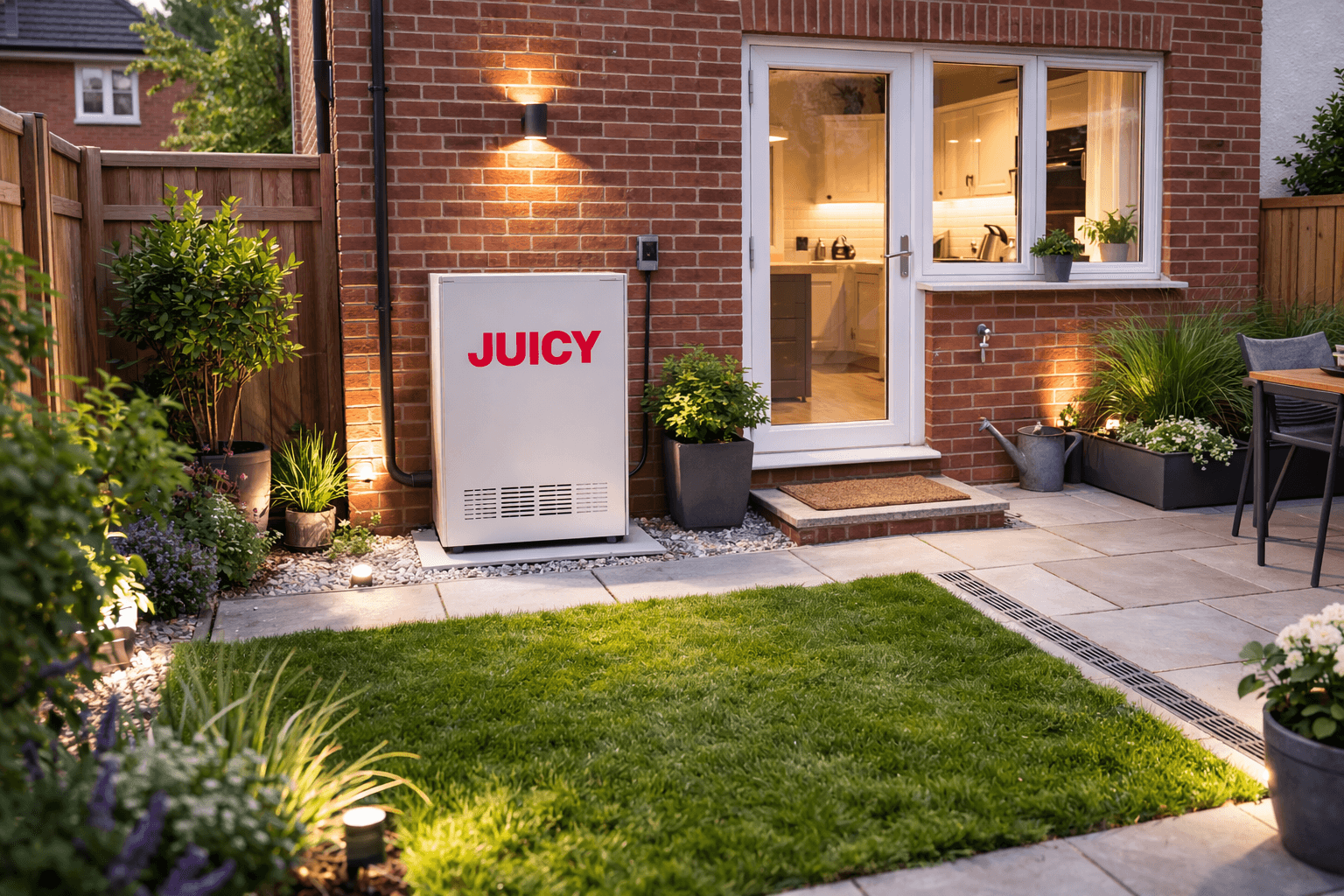
A home battery is a large rechargeable unit, typically around 10 kWh, installed in your home - usually a garage, utility room, or on an external wall. It connects to your electricity supply and can charge from the grid and discharge to power your home.
On its own, that's not particularly useful. The clever part is the software that controls it.
Juicy's system connects to your energy tariff and monitors price fluctuations in real time. When electricity is cheap, typically between midnight and 6am on most time-of-use tariffs, it automatically charges the battery. When prices rise in the morning and evening, your home draws from the battery instead of the grid.
You carry on as normal. You cook when you want, watch TV when you want, put the washing on when you want. The battery quietly handles the economics in the background.
How much can you actually save?
A typical household uses around 8-10 kWh of electricity per day. A 10 kWh battery can, in theory, cover most of that from stored cheap-rate power.
In practice, the saving depends on your tariff and usage patterns. But on a time-of-use tariff, the difference between off-peak and peak rates means most households save £400-900 per year. That's roughly £1.20-£3 per day, every day, without changing anything about how you live.
One Juicy customer installed in South Devon in November 2025 saves around £2 per day, around £700-800 per year. At that rate, their battery pays for itself in under five years. The battery carries a 15-year warranty. The math works.
Does a home battery help the grid too?
There's another benefit that doesn't show up on your energy bill, but matters over time.
In 2024, the UK discarded 8.3 terawatt hours of wind energy, power that was generated but couldn't be used because the grid couldn't get it where it was needed. Consumers paid more than £393 million in direct costs as a result [3]. That money ultimately flows back through everyone's bills.
Home batteries help solve this. When thousands of batteries charge overnight, when renewable generation is high and demand is low, they act as a buffer for the grid. They absorb energy that would otherwise be wasted and release it when it's needed most.
This is part of why Juicy is able to offer the ongoing optimisation cost to a minimum. As well as saving you money, your battery participates in grid balancing services, and that value flows back to you in the form of lower service costs.
Do you need solar panels?
No, and this is probably the most common misconception about home batteries.
Solar panels generate electricity from sunlight and use a battery to store the surplus. That's a great system if you have a suitable roof and the upfront budget. But a standalone battery works completely differently. It saves money by shifting when you buy electricity from the grid, not by generating your own. You're still using grid power, you're just buying it at the cheapest time and using it when prices are highest.
For the majority of UK homes, flats, terraced houses, properties with north-facing roofs or planning restrictions, solar simply isn't practical. A standalone battery is available to all of those households.
Do you need to do anything once it's installed?
Once your Juicy battery is installed and set up, no. The software handles everything automatically. There's no need to monitor tariff prices, set timers, or adjust settings. Juicy's system adapts to your tariff and your household's usage patterns, and updates itself remotely as things change.
The one thing that makes a meaningful difference is being on a time-of-use tariff. If you're not already on one, Juicy will recommend the best option for your situation. It takes minutes, and it's where most of the saving comes from.
Is a home battery right for every home?
Honestly, not quite. A home battery works best if you:
Have space for installation (a garage, utility room or sheltered external wall)
Are on, or willing to switch to, a time-of-use tariff
Use a reasonable amount of electricity at home (most households do)
Don't already have solar panels (Juicy currently focuses on standalone battery customers)
If that sounds like you, the economics are straightforward. A Juicy battery costs from £3,499 installed . Most households save the upfront cost within five to seven years and then keep saving for another ten years after that.
Checkout out our savings calculator to see what you could save.
Sources
[1] House of Commons Library, Gas and electricity prices during the 'energy crisis' and beyond, updated February 2026. Bills remain around 44% above winter 2021/22 levels. https://commonslibrary.parliament.uk/research-briefings/cbp-9714/
[2] Ofgem, Changes to energy price cap between 1 January and 31 March 2026, December 2025. Average electricity unit rate under the standard variable tariff is 27.69p/kWh. https://www.ofgem.gov.uk/news/changes-energy-price-cap-between-1-january-and-31-march-2026
[3] Renewable Energy Foundation, Discarded wind energy increases by 91% in 2024, 2025. 8.3 TWh of wind energy was discarded in the UK in 2024, at a direct cost to consumers of more than £393 million. https://www.ref.org.uk/ref-blog/384-discarded-wind-energy-increases-by-91-in-2024
Savings estimates based on typical household electricity usage on a time-of-use tariff. Actual savings vary depending on your consumption, tariff and battery configuration. Case study figures are from a real customer installed in November 2025 and may not be representative of all households.